Is CDL School Worth the Cost in 2026?
Social media gives you two opposite answers to this question: "CDL school changed my life" and "trucking is dead, don't bother." Neither is the full picture. The honest answer in 2026 depends almost entirely on one thing — whether you choose a real training program or one of the thousands of "CDL mills" that federal regulators have spent the last year shutting down.
This guide breaks down the real cost versus what you can actually earn, explains the FMCSA crackdown you need to know about before picking a school, and includes a checklist to verify any program is legitimate before you pay a dollar.
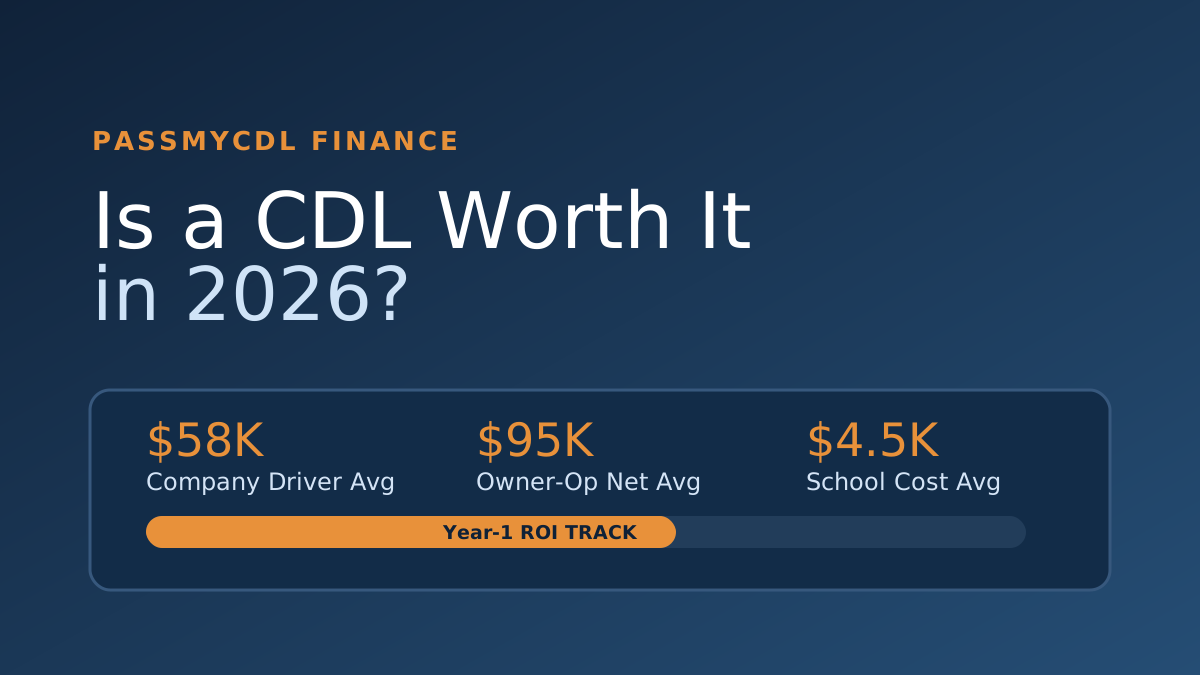
The short answer: Yes, CDL school is worth it for most people — if it's a real school. Training costs $3,000 to $8,000 and takes 4 to 8 weeks. First-year pay is commonly $50,000 to $65,000. That investment is usually paid back within 2 to 4 months of working. The catch is picking a legitimate program, because federal regulators have removed over 7,000 training providers since late 2025 for fraud and missing instruction.
The numbers: cost vs. first-year pay
Compared to most career training paths, this is an unusually fast payback. A two-year associate degree or a four-year bachelor's degree both cost far more and take years before you see any income at all. CDL training puts you in a paying seat behind the wheel within two months in many cases — and the investment is typically recovered within the first few months of work.
The FMCSA crackdown you need to know about
This is the single biggest change in the CDL training landscape in years, and most articles about "is CDL school worth it" don't mention it at all. Since late 2025, federal regulators have been removing training providers from the official registry at a scale never seen before.
⚠️ Over 7,000 CDL Training Providers Removed Since Late 2025
The Federal Motor Carrier Safety Administration (FMCSA) has removed more than 7,000 CDL training providers from its Training Provider Registry (TPR) — the largest enforcement action against commercial driver training in the agency's history. Roughly 44% of all schools that were once registered have been removed or placed under investigation.
The most common violations: unqualified instructors who didn't hold a valid CDL for the vehicle class they taught, falsified ELDT completion records for students who received little or no real instruction, and missing behind-the-wheel training entirely — some programs offered certification in as little as 2 days using only videos or simulator time.
If your training was completed through a provider that has since been removed from the registry, your ELDT certification may be invalid, and you could be required to retrain and retest before a carrier will hire you. This is exactly why verifying a school's status matters more in 2026 than it ever has before.
Check your school before you pay
Tap each item below that applies to a school you're considering. We'll give you an honest read on whether it looks legitimate or whether it shows CDL mill warning signs.
🔍 CDL School Red Flag Checker
Check any of the following that are true about the school you're considering, then see your result.
How to verify a school the right way
The checklist above flags warning signs. Here's the actual verification step that matters most.
- Search the FMCSA Training Provider Registry directly at tpr.fmcsa.dot.gov. Search the school's exact name. If it isn't listed as currently active, any ELDT certificate they issue you will not be valid for getting your CDL.
- Ask how many behind-the-wheel hours are included and get it in writing. Real Class A training includes substantial supervised driving time — not just classroom instruction or simulator sessions.
- Ask instructors directly what CDL class they hold and how long they've driven professionally. A legitimate program will have instructors who can answer this confidently and specifically.
- Be skeptical of program lengths under 3 weeks for Class A. Real ELDT training cannot be safely compressed into a few days — FMCSA has stated this explicitly as the basis for its enforcement actions.
- Check for accreditation and reviews beyond the school's own website. Look for mentions in local news, state licensing boards, or independent driver forums.
If you've already completed training: Before applying to carriers, search the FMCSA Training Provider Registry to confirm your school is still listed as active. If it was removed after you trained, contact FMCSA and your state DMV to find out whether your certification is still valid or whether you need to retrain.
Cheap and fast vs. legitimate — what you actually lose
The appeal of a 2-day, $2,000 program is obvious. The hidden cost is what you don't learn, and it follows you into your paycheck for years.
| Skill area | What a real program covers | What a CDL mill often skips |
|---|---|---|
| Trip planning | Route efficiency, fuel stops, time management | Skipped entirely — affects miles and pay later |
| Pre-trip inspection | Real mastery of every component and why it matters | Memorized just enough to pass the test |
| Backing and maneuvering | Varied real-world scenarios, tight spaces, docks | Only practiced in cone courses, not real conditions |
| Defensive driving | Hazard recognition that prevents accidents | Minimal coverage, mostly theoretical |
| Hands-on hours | Substantial supervised real driving time | Replaced with videos or simulator time |
These aren't abstract differences. Drivers who skip real instruction in these areas tend to drive less efficiently, have more avoidable incidents, and take longer to reach the higher pay tiers that come with a clean safety record and strong on-the-job performance.
How fast you actually pay it back
This is the number that should drive your decision more than the sticker price alone.
| Training cost | First-year salary | Time to break even |
|---|---|---|
| $3,000 | $50,000/yr | ~3 weeks of gross pay |
| $5,000 | $55,000/yr | ~5 weeks of gross pay |
| $6,500 | $60,000/yr | ~6 weeks of gross pay |
| $8,000 | $65,000/yr | ~6–7 weeks of gross pay |
Even at the higher end of legitimate training costs, the investment is recovered in under two months of working. Compare that to almost any other vocational or college path, and CDL training remains one of the fastest financial paybacks available — provided the training itself was real.
Don't let the crackdown scare you off: The FMCSA enforcement wave is a sign the system is correcting itself, not a reason to avoid CDL school altogether. It means the schools still standing — and properly verified through the TPR — are increasingly the legitimate ones. This actually raises the value of training completed at a real, compliant program going forward.
Free vs. paid training — does it change the math?
Employer-sponsored training, where a carrier pays for your CDL school in exchange for a work commitment, removes the upfront cost question entirely. The tradeoff is usually a 1 to 2 year commitment to that carrier and sometimes lower starting pay during that period.
- Paid out of pocket: Higher upfront cost, but more freedom to choose your first employer and route type once licensed.
- Employer-sponsored: Little to no upfront cost, but you're committed to that carrier for a set period, sometimes with a payback clause if you leave early.
- Either way — verify the school: The FMCSA crackdown applies regardless of who is paying. An employer-sponsored program at a non-compliant school carries the same risk as paying for one yourself.
For the full breakdown of every cost involved — including state fees, the DOT physical, and endorsement costs — see How Much Does a CDL Cost in 2026? And once you're licensed, see How Much Do CDL Truck Drivers Make? for a full pay breakdown by job type and endorsement.
Start studying before you even pick a school
Free CDL lessons let you learn the General Knowledge and Air Brakes material before you ever set foot in a training program — which means less time and money spent re-learning basics once you enroll.
Is CDL School Worth It — FAQ
Is CDL school worth it in 2026?
For most people, yes. Training costs $3,000–$8,000 and takes 4–8 weeks, while first-year pay is commonly $50,000–$65,000. The investment is usually recovered within a few months — as long as you choose a legitimate, FMCSA-registered school rather than a CDL mill.
What is a CDL mill and why does it matter?
A CDL mill fast-tracks students through licensing with minimal real instruction, sometimes promising certification in 2–7 days. FMCSA has removed over 7,000 training providers since late 2025 for falsified records and missing behind-the-wheel training. Training from a removed provider may not be valid.
How do I check if a CDL school is legitimate?
Search the school's name directly on the FMCSA Training Provider Registry at tpr.fmcsa.dot.gov before enrolling. Also confirm instructors hold a valid CDL, the program includes real supervised driving hours, and the timeline is realistic — rarely under 3 weeks for Class A.
How much does CDL school typically cost in 2026?
Legitimate programs typically cost $3,000–$8,000 depending on length and region, plus smaller costs for the CLP, DOT physical, and drug screening. Programs under $2,000 promising certification in a few days are a common CDL mill red flag.
How long does it take to earn back CDL school costs?
Most graduates recover their training cost within 2–4 months of starting work. At $50,000–$65,000 first-year pay, a $5,000 investment is typically earned back in 5–7 weeks of gross income.
Get ahead before you even start CDL school
Studying the General Knowledge and Air Brakes material in advance means you walk into training already understanding the fundamentals — making the most of every dollar you spend on school.
Start Free Lessons →