Is a CDL Worth It in 2026?
A CDL is worth it in 2026 when the license creates a clear and reasonably fast income step-up compared with your current work. That is the real test. The question is not whether trucking can pay well in some abstract way. The question is whether your own training cost, time investment, and likely first job create a payback story that makes sense.
That distinction matters because people often evaluate a CDL using the wrong data. They hear a high gross income number online, assume the license automatically produces that result, and skip the details that actually drive return on investment. Training cost, time off work, route type, employer quality, unpaid waiting, benefits, and financing terms all matter more than a flashy top-line salary claim.
This article takes a practical approach. Instead of pretending there is one universal answer, it shows how to think through the decision like an operator: what the license costs, what your first-year income path may look like, what can go wrong, and how endorsements can improve the opportunity set.
What makes a CDL financially worth it?
A CDL becomes financially worth it when the increase in earning power pays back the upfront cost fast enough to justify the time, risk, and lifestyle tradeoffs.
That sounds obvious, but it forces you to use the right framework. You are not buying a title. You are buying access to work. If that access produces better hourly value, more stable employment, stronger upward mobility, or a path into specialized freight, the license has economic value. If the license only replaces one unstable job with another unstable job while adding debt, the answer changes.
Three questions matter most:
- How much cash do you need to spend before you are fully licensed and employable?
- How quickly can you move from training into consistent paid work?
- How much better is your post-CDL income than your current alternative?
If you can answer those three clearly, most of the decision becomes mechanical. If you cannot answer them, you are still in marketing territory rather than planning territory.
How much does it cost to get a CDL?
The true cost of getting a CDL includes more than tuition. It also includes permit fees, medical and testing costs, transportation, gear, and any income you lose while training.
That last piece is what many students miss. If school costs a few thousand dollars but you also give up several weeks of regular earnings, your real investment is much larger than the invoice from the school. For someone living close to the edge of their budget, lost income can matter as much as tuition.
A reasonable student budget usually includes:
- Training tuition or contract-school obligations.
- Permit, background, and testing fees.
- DOT medical and basic onboarding costs.
- Transportation to school or lodging if training is not local.
- Temporary income loss while your schedule is disrupted.
Contract training can reduce cash up front, but it is not free. It often changes job flexibility and bargaining power in the first stage of your career. If you use that route, compare the lower initial cash requirement with the possibility of being tied to a lower-pay or less flexible first employer.
How fast can a CDL pay for itself?
A CDL can pay for itself quickly if you move into steady work soon after licensing, but the payback window depends on your actual cost base and first-year take-home income.
The cleanest way to think about ROI is to build scenarios instead of chasing one number. Use a conservative case, a base case, and a strong case. That approach keeps you from building your life around the most optimistic outcome.
| Scenario | Upfront cost | Early work pattern | What payback looks like |
|---|---|---|---|
| Conservative | Higher tuition and some lost income during training | Slow start with uneven miles or inconsistent local hours | Longer payback window, so cash reserves matter. |
| Base case | Moderate school cost and manageable fees | Stable first employer and regular schedule within the first few months | Payback can happen within the first working year. |
| Strong case | Low debt plus quick placement | Consistent miles or premium local role with overtime | The license pays back very quickly and opens room for endorsements or better lanes. |
The point is not to predict the future perfectly. The point is to stop making the decision with zero model at all. A CDL can have excellent ROI, but that does not mean every school, every job offer, or every financing structure produces excellent ROI.
Want the fastest path into higher-value endorsements?
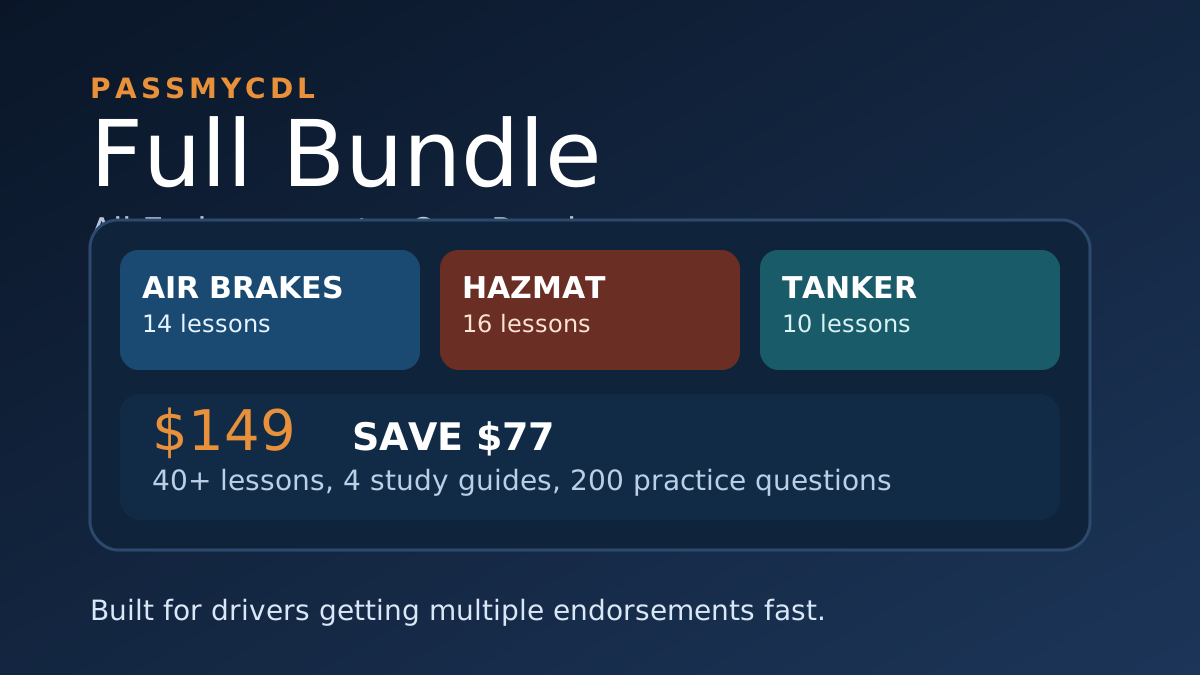
The Full Bundle gives you Air Brakes, Hazmat, and Tanker prep in one system so you can study once and expand your job options faster.
What changes between local, regional, and over-the-road jobs?
Local, regional, and over-the-road jobs change the CDL value equation because they trade income structure against home time, predictability, and unpaid inefficiencies.
Local work can be attractive if you want home time and a more normal routine. The tradeoff is that some local jobs involve physically demanding work, variable start times, and income that depends on route efficiency or overtime. Regional and OTR roles can offer strong earning potential, but the lifestyle cost is higher and the quality of the dispatch operation matters much more.
When students ask whether a CDL is "worth it," they often mean which version of driving is worth it. That is a better question. A good local job and a weak OTR job are not the same opportunity just because both require the same license.
Look at these factors before comparing offers:
- How consistent are miles, loads, or scheduled hours?
- How much waiting time is unpaid?
- What benefits, reimbursement, or time-off structure is included?
- How often will you actually be home?
- How fast can you move into specialized freight or a better lane?
Why do owner-operator numbers confuse new drivers?
Owner-operator numbers confuse new drivers because gross revenue sounds impressive while net income is where the real business answer lives.
It is easy to see why the confusion happens. A truck can bill a lot of money over a year, and social media tends to talk about revenue as if it were personal salary. But fuel, maintenance, tires, insurance, permits, downtime, factoring, repairs, trailer costs, taxes, and equipment financing can change the picture completely.
That does not mean owner-operator work is bad. It means it is a business model, not just a driving job. New drivers should be especially careful with any pitch that jumps from top-line revenue directly to lifestyle promises without showing the cost stack in between. If your goal is steady early-career ROI, company driving or a high-quality specialized company role can be the cleaner first step.
When is a CDL probably not worth it?
A CDL is probably not worth it when you must take on expensive debt, have no realistic path to stable work, or strongly dislike the schedule and physical demands tied to the available jobs in your market.
This is the part many marketing pages skip. A license is not automatically a good fit. If the only training option available to you creates a heavy financial burden, and the likely first jobs near you are low quality or unstable, the ROI case weakens quickly. The same is true if you know you will not tolerate nights away from home, irregular sleep, or long periods of sitting and waiting.
Warning signs to take seriously:
- You are financing more training cost than you can comfortably absorb.
- You have not researched real entry-level hiring options where you live.
- You are relying on gross pay claims without understanding deductions or unpaid time.
- You are assuming endorsements will help without a plan to earn them and use them.
If two or three of those are true at once, pause. The goal is not to talk yourself out of the license. The goal is to tighten the plan before you commit.
How can you improve CDL ROI before you enroll?
You can improve CDL ROI before you enroll by reducing avoidable costs, choosing a training path with a clean employment outcome, and targeting endorsements that make you more versatile.
Most ROI gains come from preparation, not luck. If you enter school already knowing which employers hire in your area, what freight types interest you, and which endorsements are worth adding next, you shorten the time between license and better earnings.
Practical ways to improve the outcome:
- Compare schools on placement quality, not just tuition.
- Build a realistic first-year budget that includes lower-income months.
- Avoid assuming owner-operator is the immediate next step.
- Add Air Brakes, Hazmat, and Tanker prep if those endorsements fit your path.
- Choose the first job for skill building and consistency, not just the loudest advertised number.
That last point matters. A clean first year with consistent work often does more for long-term income than chasing the most exciting headline. Strong habits, safe miles, and good endorsements compound.
CDL ROI FAQ
Is a CDL worth it in 2026?
It can be, if the license creates a real earnings step-up and the training cost stays manageable. The right way to decide is to compare your full cost with your likely first-year work options.
How much does it cost to get a CDL?
Count tuition, permit and testing costs, DOT medical requirements, transportation, and any wages you lose while training. Your own total matters more than anyone else’s average.
How fast can a CDL pay for itself?
Payback depends on cost control and how quickly you get into stable work. Many students should think in scenarios rather than betting on one best-case timeline.
Is owner-operator income better than company-driver income?
Not automatically. Owner-operator gross revenue can be much higher, but net income after expenses is the number that matters for a real ROI decision.
What improves CDL ROI the most?
Lower debt, faster placement into reliable work, better route selection, and useful endorsements usually improve return on investment the most.
Want the highest-value endorsement bundle?
Use one structured study system for Air Brakes, Hazmat, and Tanker instead of piecing it together from random videos and question banks.
Get the Full Bundle - $149