CDL Tanker Endorsement: Complete Study Guide
The CDL tanker endorsement (code N) is one of the most straightforward endorsements to get — no TSA background check, no additional skills test, no waiting period. You study, you take a 20 to 25 question knowledge test, and you pass with 80% or better. That's it.
What makes the tanker test harder than people expect is the physics. Liquid moves inside a tank. It surges forward when you brake, sideways when you turn, and shifts the center of gravity in ways that solid cargo never does. The test is built around whether you understand that movement and can respond to it correctly. This guide covers every topic on the test with clear explanations — especially liquid surge, which is the most tested and most misunderstood concept.
Quick facts: N endorsement · 20–25 questions · 80% to pass · knowledge test only · no TSA check · no skills test · no ELDT theory training required · can be taken same day as your CDL general knowledge test.
Who needs the tanker endorsement?
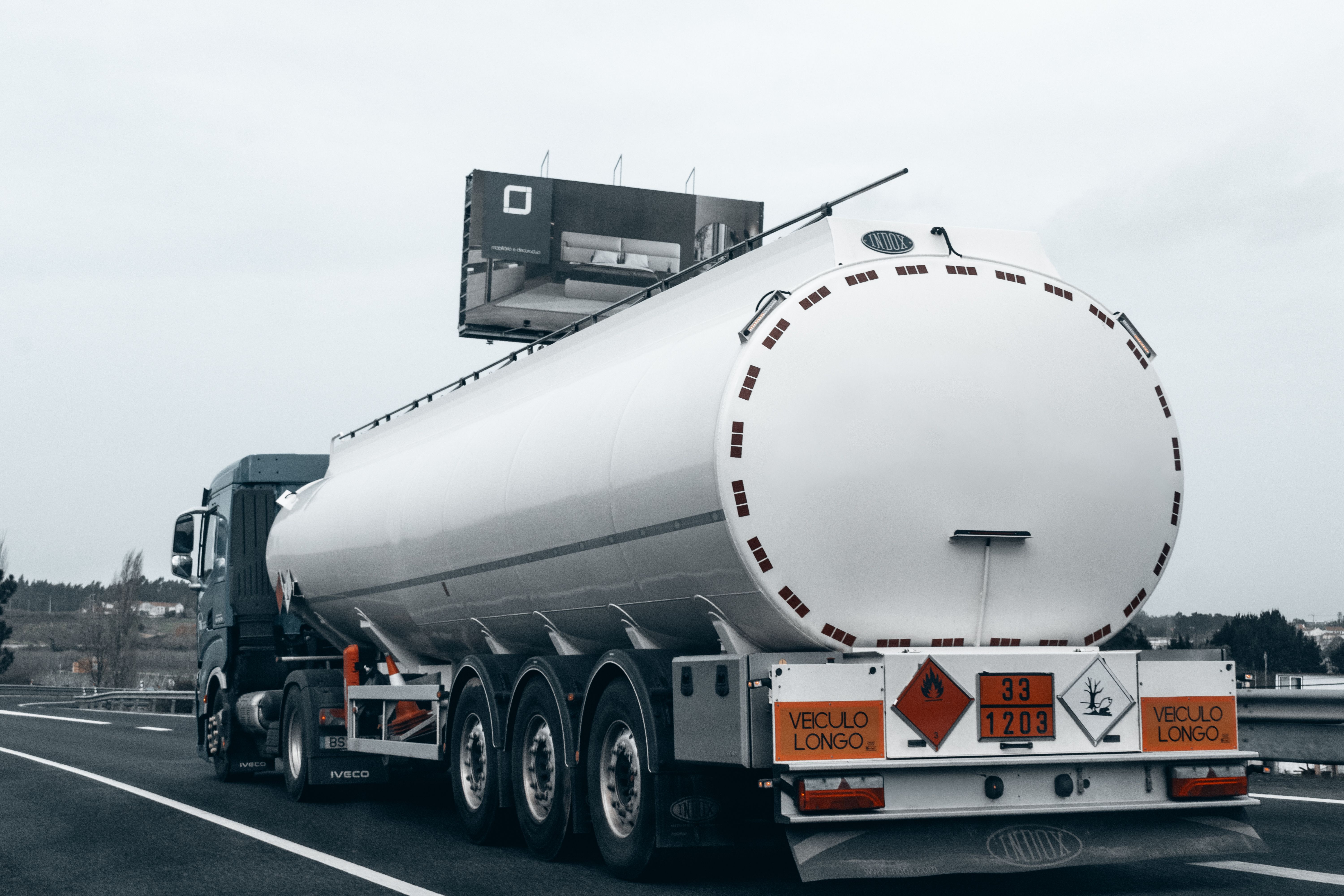
You need the N endorsement any time you drive a commercial vehicle that has a permanently or temporarily attached tank designed to transport liquid or gaseous materials in a quantity of 1,000 gallons or more.
Common tanker driver jobs that require the N endorsement:
- Milk and dairy tanker driver
- Water hauler
- Food-grade liquid transport (juices, syrups, cooking oils)
- Chemical tanker driver (non-hazmat)
- Fuel hauler — requires N plus H (hazmat) = X endorsement
- Propane and compressed gas transport — requires N plus H
- Waste water and sewage tanker
One important distinction: if you haul a flatbed with IBC totes or portable tanks, those are not permanently attached tanks. Whether the N endorsement is required depends on the total capacity and whether the tanks are designed to be permanently mounted. When in doubt, check with your employer or state DMV.
N endorsement vs X endorsement — what is the difference?
Many people confuse the N and X endorsements. The difference is simple:
Milk, water, food grade
$50,000–$65,000/yr
Requires TSA check
$55,000–$70,000/yr
Both N and H required
$65,000–$85,000/yr
Fuel hauling — which is what most people picture when they think of tanker driving — requires the X endorsement. That means getting both the N endorsement (knowledge test only) and the H endorsement (knowledge test plus TSA background check). The N part is easy and fast. The H part takes 30 to 60 days because of the TSA process.
If your goal is fuel hauling, read the hazmat endorsement guide alongside this one. Start the TSA process for hazmat while you study for both knowledge tests.
Liquid surge — the most important concept on the tanker test
Liquid surge is the movement of liquid inside a partially filled tank when the driver changes speed or direction. Understanding surge is not just important for the test — it is the core safety skill for tanker driving. More tanker accidents are caused by surge-related loss of control than any other factor.
🌊 How liquid moves in a tank
The test asks about surge in several forms. Some questions ask what surge is. Others describe a scenario and ask how a driver should respond. The key facts to memorize:
- Partially filled tanks create the most surge. A full tank has no room for liquid to move. An empty tank has nothing to surge. The worst surge happens at roughly half full — there is room for the liquid to build momentum before hitting the tank wall.
- Baffles reduce front-to-back surge but not side-to-side slosh. This is the most tested surge fact. Baffled tanks have internal dividers that slow the liquid's movement forward and backward, but liquid can still move sideways between and around the baffles.
- Smooth bore tanks have no baffles. Used for food-grade products like milk and juice because baffles trap residue. Smooth bore tanks have maximum surge — drivers must be extremely smooth with braking and acceleration.
- Surge adds to your stopping distance. The forward momentum of the liquid continues pushing the vehicle even after the brakes are applied. Always leave more following distance in a tanker than you would in a standard trailer.
Memory trick: Think of a glass of water being carried. Walk fast and stop suddenly — the water keeps moving forward. That is exactly what happens in a tanker. The bigger the tank and the more air space, the bigger the wave. Baffles are like putting a hand across the glass — they slow the wave front-to-back, but the water still sloshes side to side.
The three types of tanker vehicles — what the test expects you to know
The test distinguishes between three types of tanks by their internal structure. Each has different surge characteristics and different typical uses.
Smooth Bore Tank
Surge: Maximum- No internal baffles or dividers
- Used for food-grade liquids (milk, juice, edible oils)
- Easy to clean — no baffles trap residue
- Requires the smoothest driving technique
- Most surge of all three types
Baffled Tank
Surge: Reduced front-back- Internal walls with holes slow front-to-back movement
- Used for petroleum, chemicals, water
- Reduces forward surge when braking
- Does NOT reduce side-to-side slosh in turns
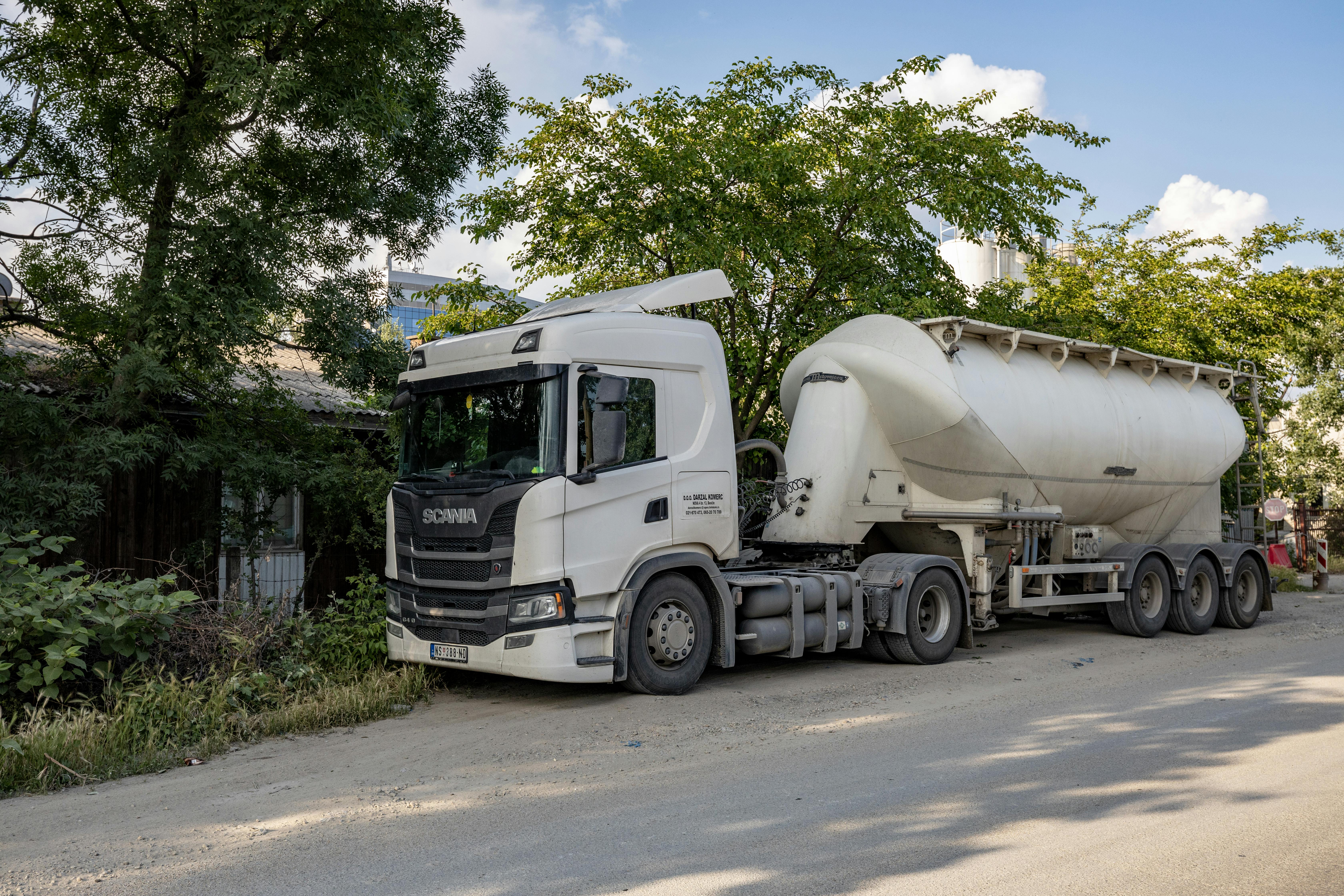
- Most common tanker type on the road
Compartmented Tank
Surge: Least- Divided into separate sealed sections
- Can carry different liquids at once
- Used for fuel delivery (multiple grades)
- Least surge because liquid cannot travel the full tank length
- Each compartment must be checked separately
Rollover prevention — high center of gravity rules
Tanker trucks have a higher center of gravity than standard dry van trailers. Liquid cargo shifts during turns, raising the effective center of gravity even higher. This combination makes tankers significantly more prone to rollover than other commercial vehicles.
The test asks about rollover prevention in several ways. Here are the key rules:
| Situation | Rule | Why it matters |
|---|---|---|
| Highway curves and ramps | Drive well below the posted speed limit — typically 10–15 mph below for tankers | Posted speed limits are for cars. A loaded tanker has a much higher center of gravity and more lateral force in curves. |
| On-ramps and off-ramps | Slow down before entering the curve, not during it | Braking in a curve shifts liquid sideways AND forward simultaneously — double rollover risk |
| Turns at intersections | Take turns wide and slow. Never brake mid-turn. | Lateral surge during a turn shifts the center of gravity toward the outside wheel — this is how rollovers start |
| Load level | Avoid driving at the most dangerous fill levels (roughly quarter to three-quarter full) | These fill levels give liquid the most room to build surge momentum. Full or nearly empty tanks are more stable. |
| Emergency stops | Brake smoothly and early — never slam brakes with a liquid load | Hard braking on a partially filled tanker causes massive forward surge that can override the braking force |
The most tested rollover rule: Speed limits on curves are set for cars and standard trucks. A tanker truck should take curves at significantly lower speeds — often 10 mph or more below the posted limit. The test may give you a curve with a posted 35 mph limit and ask what speed is appropriate for a loaded tanker. The correct answer is slower than posted.
Tanker vehicle inspection — what is unique
The tanker pre-trip inspection includes everything in a standard CDL pre-trip inspection plus additional tank-specific checks. The test asks about these tanker-specific items because they are not covered in the general knowledge section.
- Manhole covers and vents: Must be closed and secure before driving. Open vents cause spills. Check that vent caps are not clogged.
- Valves and outlets: All discharge valves must be fully closed and secured before departure. A partially open valve during transit is a major spill hazard.
- Piping and connections: Check all pipes, hoses, and fittings for leaks, cracks, or loose connections. Pay special attention to the pump and meter connections if equipped.
- Emergency shutoff valves: Must be present and operational on tanks carrying hazardous liquids. Verify they open and close correctly.
- Tank body and structure: Check for dents, cracks, or deformation in the tank shell — these can indicate structural weakness. A cracked tank can fail under pressure or surge forces.
- Baffles (if applicable): Must be secure and undamaged. A loose baffle can shift during transit, changing the surge dynamics unexpectedly.
- Grounding cable (if applicable): For flammable liquid tankers, grounding cable prevents static discharge during loading and unloading.
Loading and unloading rules for tankers
The test covers several specific rules for loading and unloading liquid cargo that do not apply to dry freight.
- Do not overload: Every tank has a maximum capacity rating. Overfilling leaves no space for thermal expansion of the liquid — pressure can build and damage the tank or blow a vent.
- Weight distribution: When loading a compartmented tank, distribute weight as evenly as possible. An uneven load raises rollover risk on one side significantly more than the other.
- Ground the vehicle first: For flammable liquids, always connect the grounding cable before opening any valve to prevent static spark ignition.
- Attend the vehicle during loading: Never leave a tanker unattended while it is being loaded or unloaded. Overfills and valve failures can happen quickly.
- Check the right product: Before loading, confirm the product being loaded matches what the tank is rated and cleaned for. Cross-contamination between loads is a serious safety and quality issue.
How to get the tanker endorsement — step by step
Unlike the hazmat endorsement, the tanker process is fast and simple. No TSA, no waiting, no extra skills test.
- Have a valid CDL or be getting one: You must already have a CDL, or you can take the tanker knowledge test at the same time as your general knowledge test on your first CDL visit.
- Study the tank vehicles section of the FMCSA CDL manual: This is the primary source for all test questions. Focus on liquid surge, tank types, rollover prevention, and inspection procedures.
- Take the N endorsement knowledge test at your state DMV: 20 to 25 questions, 80% to pass. No appointment needed in most states — walk in same day as your other CDL tests.
- Pay the endorsement fee: Usually $5 to $30 depending on state. Some states include it in the CDL license fee.
- CDL updated immediately: Pass the test and the N endorsement is added to your CDL the same day.
Timing tip: Take the tanker knowledge test on the same day as your general knowledge test and air brakes test. You walk in, take all three written tests in one visit, pay one trip's worth of fees, and leave with all three endorsements. It costs no extra time and only requires extra study.
Practice quiz — test yourself now
These 8 questions cover the core tanker test topics. Try each one before reading the explanation.
🚛 Tanker Knowledge Quiz
8 questions · FMCSA manual topics · tap an answer to check it
How to study for the tanker test in one week
The tanker test is shorter than the general knowledge test and covers a more focused set of topics. One week of targeted study is enough for most candidates.
- Day 1: Read the tank vehicles chapter of the FMCSA CDL manual. Do not take notes yet — just read for overall understanding.
- Day 2: Focus on liquid surge. Write the three surge scenarios (brake, turn, accelerate) from memory. Write the difference between smooth bore, baffled, and compartmented tanks.
- Day 3: Study rollover prevention. Write the speed rule for curves. Understand why braking in a curve is dangerous for a tanker specifically.
- Day 4: Study the tanker inspection section. List the items unique to tank vehicles that are not on a standard pre-trip checklist.
- Day 5: Take practice questions. Focus on the ones you get wrong and review those specific sections.
- Day 6: Review the loading and unloading section. Understand the grounding rule and the overfill rule.
- Day 7: Full practice quiz run. If you are scoring 80% or above consistently, you are ready. If not, revisit the sections where you are losing points.
Structured lessons for the tanker endorsement
The PassMyCDL Tanker Pack covers liquid surge physics, all three tank types, rollover prevention, tanker inspection, and loading rules across structured video lessons — plus practice questions built from the exact FMCSA topics that appear on the test.
Tanker Endorsement FAQ
What is the CDL tanker endorsement?
The N endorsement authorizes you to drive commercial vehicles designed to carry liquid or gaseous materials in bulk tanks of 1,000 gallons or more. It covers milk tankers, water haulers, food-grade liquids, and non-hazardous chemicals. For hazardous liquids like fuel, you need the X endorsement (N plus H).
How many questions are on the tanker test?
The tanker knowledge test has 20 to 25 questions depending on the state. You need 80% correct to pass. The test focuses heavily on liquid surge, baffled versus smooth bore tanks, rollover prevention, and tanker inspection procedures.
Does the tanker endorsement require a TSA background check?
No. The N endorsement is a knowledge test only. No TSA check, no fingerprinting, no waiting period. You can take it the same day as your general knowledge test and get it added to your CDL immediately.
What is the difference between N and X endorsement?
N is tanker only — for non-hazardous liquids. X is N plus H (hazmat) combined — required for hauling fuel, chemicals, and any placarded liquid cargo. Fuel hauling jobs require the X endorsement, not just N.
What is liquid surge and why is it tested?
Liquid surge is the movement of liquid inside a partially filled tank when you brake, turn, or accelerate. It extends stopping distance, increases rollover risk in turns, and makes tankers much harder to control than solid-cargo vehicles. It is the most important concept on the tanker test because it explains why tanker driving requires different techniques than standard CDL driving.
Get the tanker endorsement — start studying today
The PassMyCDL Tanker Pack covers every topic on the N endorsement test with structured lessons and practice questions. No TSA wait, no skills test — just study and pass.
Get the Tanker Pack — $49 →