CDL Pre-Trip Inspection Checklist: Step-by-Step Guide

The CDL pre-trip inspection is the first part of your skills test — and it is where most candidates lose the most points. Not because the material is hard, but because they try to memorize a list instead of learning a system.
This guide gives you the complete zone-by-zone checklist, the exact PSI numbers you need for the air brake test, what to say to the examiner at each stop, and the most common reasons people fail. Everything is sourced directly from the FMCSA CDL manual.
Important: The pre-trip inspection is done entirely from memory. You will not have a checklist during the test. Use this guide to practice out loud — at least 10 full runs before test day. After 10 repetitions, the sequence becomes automatic.
What is the CDL pre-trip inspection?
The pre-trip inspection is the first of three parts in the CDL skills test. The other two are basic vehicle control (backing) and the on-road driving test. The pre-trip portion checks whether you know how to identify problems with your vehicle before you drive it.
During the test, an examiner follows you around the vehicle with a scoring sheet. They watch what you physically check, listen to what you say, and mark deductions for anything you miss or skip. You do not need to find actual defects — you need to show that you know what to check and what a defect would look like.
The inspection is scored in two ways. Some items are regular deductions — missing one or two will not automatically fail you. Other items are critical errors — missing any one of them ends the test immediately.
How the modernized CDL test changed the inspection
Since 2023, most states have adopted the updated CDL testing model from the FMCSA and AAMVA. If you have been using old study guides or videos from before 2023, some of the information may be outdated. Here is what changed:
- The checklist was streamlined — fewer items are required to name and describe than in the old format
- The focus shifted more toward safety-critical items — brakes, tires, steering, and coupling
- The entire vehicle is now used in testing — the old format where only sections A, B, or C of the vehicle were tested is gone
- Brake check procedures were standardized across states
The core inspection zones and sequence are the same. What changed is the depth of detail required for non-critical items. You still need to know every zone — but the examiner is now more focused on whether you understand safety systems than whether you can name every bolt and bracket.
The 7 inspection zones — complete checklist
Work through these zones in order every single time you practice. Consistency is what the examiner is looking for — a driver who follows the same system every trip is a safer driver than one who checks things randomly.
- Walk around the vehicle and look for obvious damage, leaning, or tilt
- Check under the vehicle for fresh fluid leaks — oil, coolant, fuel, brake fluid
- Look for missing or hanging parts
- Check that the area around the vehicle is clear
- Verify vehicle is not overloaded or unevenly loaded
- Engine oil — check level on dipstick, look for leaks around the pan and gaskets
- Coolant level — check reservoir or radiator cap (engine cold), no leaks from hoses
- Power steering fluid — proper level, no leaks from hoses or pump
- Windshield washer fluid — present and accessible
- Battery — secured, not cracked, no corrosion on terminals, caps present
- Alternator — securely mounted, belts not frayed or cracked, less than ¾ inch play
- Air compressor — securely mounted, no leaks from lines or fittings
- Hoses — no cracks, abrasions, bulges, or leaks
- Steering gearbox — securely mounted, no leaks
- Steering shaft — not bent, no missing cotter pins
- Water pump — not leaking, belts in good condition
- Seat and seatbelt — adjust seat, check belt for cuts or fraying, buckle works
- Mirrors — properly adjusted, no cracks
- Windshield — no cracks in driver's view, wipers work and blades in good condition
- Horn — test it works
- Heater and defroster — operate properly
- Emergency equipment — fire extinguisher charged and mounted, three reflective triangles, spare fuses if required
- Gauges — check oil pressure rises, voltage or ammeter normal, coolant temperature rising normally
- Warning lights — all lights illuminate then go off as systems come up to pressure
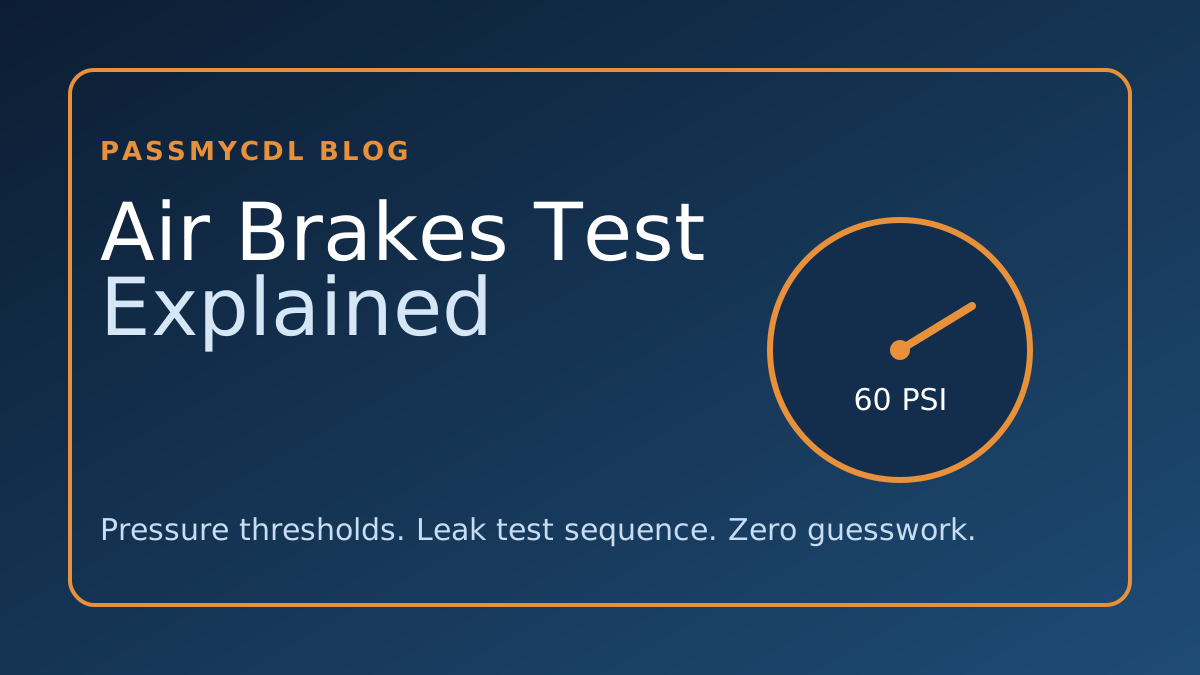
The air brake check — exact steps and PSI numbers
The air brake check is the most tested and most failed part of the in-cab inspection. Most people get the items right but perform them in the wrong order. The order matters — examiners follow a specific sequence and will mark you down for doing it out of order.
Here are the key PSI numbers to memorize before your test:
Now do the test in this exact order:
- Build full air pressure — start the engine and let air pressure build to governor cut-out (120–140 PSI). Turn engine off.
- Check that pressure holds — with engine off and brakes released, watch the gauges for 1 minute. Pressure should not drop more than 2 PSI.
- Fan the brakes down — apply and release the brake pedal repeatedly to reduce air pressure. Watch for the low-air warning light and buzzer to activate at or before 60 PSI.
- Continue fanning — keep reducing pressure. Spring brakes should apply automatically between 20 and 45 PSI.
- Leak test — rebuild pressure to governor cut-out. Apply and hold the brake pedal firmly. Watch gauges for 1 minute. Loss must not exceed 3 PSI (single) or 4 PSI (combination).
- Test the parking brake — with vehicle on flat ground, apply parking brake and attempt to move forward gently to confirm it holds.
- Test service brakes — release parking brake, move forward slowly, apply service brake and feel for pulling or unusual response.
Memory tip for the air brake sequence: Build → Hold → Fan to 60 (warning) → Fan to 20–45 (spring brakes) → Rebuild → Leak test → Parking → Service. Say this out loud five times until it becomes automatic.
- Front of vehicle — headlights (high and low beam), turn signals, reflectors, no damage to bumper or frame
- Left front tire — proper inflation, tread depth (minimum 4/32 inch on steering axle), no cuts, bulges, or exposed cords, valve stem present, dual tires not touching
- Left front wheel — lug nuts present and secure, no cracks in rim, hub seal not leaking
- Left steering components — tie rod, drag link, steering arm — no bends, cracks, or missing cotter pins
- Left front spring — not broken, properly seated, no missing leaves
- Left fuel tank — secured, cap tight, no leaks, fuel level adequate
- Left exhaust system — no leaks, not rubbing on fuel lines or wiring
- Left rear tires — same checks as front tire, minimum 2/32 tread depth on rear axle
- Left rear wheels — lug nuts tight, no cracks, hub seal not leaking
- Rear of tractor — lights, reflectors, no damage
- Fifth wheel — properly mounted to frame, no cracks, skid plate is greased
- Locking jaws — fully closed around the kingpin, release arm is secured and not in the unlocked position
- Kingpin — not bent or cracked, properly seated in the fifth wheel
- Air lines — glad hands connected and locked, no air leaks, lines not kinked or dragging
- Electrical connection — plug secured, safety catch engaged, no fraying
- Trailer landing gear — fully raised, no missing crank, no cracks in the support
- Safety chains or cables — connected, not dragging
- Trailer body — no damage, doors secured, cargo properly sealed if applicable
- Rear tires — both sides, same checks as other tires
- Rear wheels — lug nuts, rims, hub seals
- Mud flaps — present and not dragging
- Rear lights — brake lights, turn signals, reverse lights, reflectors all present and working
- Trailer rear door or gate — properly closed and latched
- ICC bar (rear impact guard) — present, not bent, properly secured
- License plate — visible and properly mounted
- Mirror — clean, properly adjusted, no cracks
- Right side tires — all same checks as left side
- Right side wheels — lug nuts, rims, hub seals
- Right fuel tank — secured, no leaks
- Right exhaust — no leaks or damage
- Right landing gear (trailer) — same as left side
- Passenger-side air lines and electrical — same as driver side checks
- Front lights check — turn on headlights and walk to the front to verify both high and low beams work, turn signals flash, clearance lights are on
What automatically fails you on the pre-trip inspection
These are not regular point deductions. Any one of these ends the test immediately.
Automatic fail — critical errors
- Not performing the air brake check at all
- Skipping the coupling system inspection on a Class A vehicle
- Not physically touching or pointing to items you name — you must show the examiner, not just talk
- Missing any safety-critical component such as steering parts, brake system, or tires with visible defects
- Not stating what defect you are looking for — saying "I'm checking the tire" is not enough; you must say what a bad tire looks like
- Performing the air brake test steps in the wrong order
- Not demonstrating that the low-air warning activated before 60 PSI
Common mistakes that cost points but do not automatically fail
| Mistake | Why it costs points | How to avoid it |
|---|---|---|
| Rushing through the engine compartment | Examiners notice when you skip items | Slow down and name each component as you check it |
| Not checking both sides of dual tires | Inner tire condition is a required check | Physically lean down and look at both tires on each axle |
| Forgetting the ICC bar or mud flaps | Easy to skip small items at the rear | Always finish at the rear lights — use that as your signal to check ICC bar and mud flaps |
| Not checking fuel tank caps | Small item with big safety consequence | Add "cap is tight, no leaks" to your fuel tank script every time |
| Skipping the lights walk to the front | You must physically go to the front to verify | Turn lights on before starting the walk-around so you remember to check them |
How to practice the pre-trip inspection effectively
Reading this guide is the start. It is not the finish. The pre-trip inspection is a physical, verbal performance — not a written test. You must practice out loud, on a real vehicle if possible, in the same order every time.
Here is the practice method that builds the fastest results:
- Read through this checklist three times until the zones and their order feel familiar
- Practice saying each zone out loud without looking at the list — just the zone names and the key items in each
- Walk through the sequence on any vehicle — even a regular car — to get your body used to moving in the right order
- Practice on a real CDL vehicle with your instructor or a licensed driver at least 5 times before test day
- Do at least 10 full timed runs — aim to complete the inspection in under 30 minutes while covering every item
- Record yourself on one run — watching the video shows you what you are missing or skipping without realizing it
The number one tip from experienced examiners: Say everything out loud. Examiners cannot give you credit for a mental check. If you look at the tire and say nothing, it did not happen. Get in the habit of narrating every single item as you inspect it.
Pre-trip inspection for the CDL knowledge test vs the skills test
There is an important difference between the written knowledge test and the actual skills test when it comes to pre-trip inspection.
On the written knowledge test, questions about the pre-trip inspection focus on what you are checking and why — the safety purpose behind each item. For example: "Why do you check the tread depth on steering axle tires?" The answer is that shallow tread on steering tires is a major blowout and control risk. You need to understand the reasoning, not just the checklist.
On the skills test, questions do not exist — you perform the inspection while being observed. The examiner scores your actions and your words, not a written answer.
Study for both. The air brakes knowledge test is closely tied to the pre-trip inspection because the in-cab brake check is one of the highest-scoring parts of the skills test.
Need the full air brakes lesson sequence?
The Air Brakes Pack covers the inspection procedure, all PSI numbers, leak test limits, and the exact in-cab check sequence across 14 structured video lessons. It is the fastest way to get the brake check right before your skills test.
Pre-Trip Inspection FAQ
What are the 7 steps of a CDL pre-trip inspection?
The 7 zones are: vehicle overview on approach, engine compartment, in-cab inspection and air brake check, driver-side exterior walk-around, rear of vehicle, passenger-side walk-around, and lights check. Class A vehicles add a coupling system inspection between the tractor and trailer.
What automatically fails you on a CDL pre-trip inspection?
Automatic failures include not doing the air brake check, skipping the coupling system on a Class A vehicle, not physically pointing to or touching items you name, missing safety-critical components, and performing the air brake steps in the wrong order.
How long do you have for the CDL pre-trip inspection?
Most states allow 30 to 40 minutes. Prepared candidates typically finish in 20 to 30 minutes. The examiner scores thoroughness, not speed — do not rush.
What PSI numbers do I need for the air brake check?
Governor cut-out: 120–140 PSI. Governor cut-in: around 100 PSI. Low-air warning: at or before 60 PSI. Spring brakes apply: 20–45 PSI. Leak test limits: 3 PSI per minute for single vehicles, 4 PSI per minute for combination vehicles.
How many times should I practice before my test?
At least 10 full practice runs out loud before test day. The inspection is from memory with no notes allowed. Ten repetitions builds the sequence into muscle memory so you stay on track under pressure during the actual test.
Start learning the CDL inspection sequence today
The PassMyCDL free lessons cover pre-trip inspection concepts, air brake systems, and the exact procedures the written test asks about — all from the FMCSA manual. Free, no account needed.
Start 48 Free Lessons →