

Illinois CDL Practice Test 2026
Free IL CDL test prep — general knowledge, air brakes, hazmat & tanker
20 Free Practice Questions
Full Explanations & Citations
Triple-Trailer Ban Explained
2026 Secretary of State Fees
50 Qs
General Knowledge
80%
to pass
No triples
allowed in IL
$50
CLP application fee
4 years
CDL validity
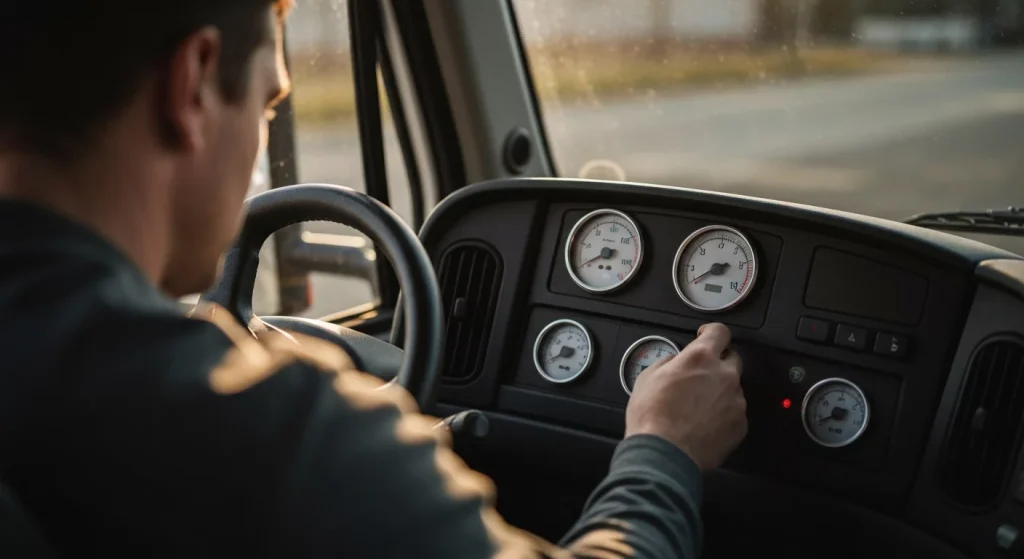
Illinois sits at the convergence of I-55, I-80, I-90, and I-94 — and Chicago is one of the largest rail and truck intermodal hubs in North America. That makes Illinois one of the busiest freight states in the country, but it also means the Illinois Secretary of State enforces some rules that don’t exist everywhere else, including a complete ban on one type of combination vehicle most other states allow.
An Illinois Rule Most Out-of-State Drivers Don’t Know
Illinois prohibits triple trailers entirely, regardless of what your CDL endorsements allow elsewhere. If you hold a T (Doubles/Triples) endorsement, it only authorizes double trailer combinations within Illinois — not triples. Drivers routing through Illinois with a triple combination from a state where it’s legal need to plan an alternate route or reconfigure before crossing the state line.
Illinois CDL at a glance — 2026 requirements
$50
CLP application fee
$60
CDL issuance fee
$5
Endorsement/upgrade fee
4 yrs
CDL renewal cycle
|
Requirement |
Illinois rule |
|---|---|
|
Min age (intrastate) |
18 years old — Illinois-only driving |
|
Min age (interstate/passengers) |
21 years old — across state lines or transporting passengers |
|
Prerequisite license |
Valid Illinois CDL or non-CDL license as base license |
|
CLP hold period |
14 days minimum before skills test |
|
CLP validity |
Up to 180 days — renewable 30 days before to 5 days after expiration |
|
CDL validity |
4 years |
|
Triple trailers |
Prohibited entirely — T endorsement covers doubles only |
|
Out-of-state convictions |
Must notify Illinois Secretary of State within 30 days |
|
Administering agency |
Illinois Secretary of State (not a separate DMV) |
|
Multiple CDLs |
Illegal — holding CDLs in more than one state risks jail time and fines up to $5,000 |
Escalating retest penalty: Illinois uses a three-tier wait period for repeated knowledge test failures — 30 days after 3 failures, 90 days after 6 failures, and a full year after 9 failures. Extra fees apply after every three failed attempts. Study thoroughly before each attempt rather than treating the test as low-stakes trial and error.
Illinois CDL test structure
|
General Knowledge Test |
|
|---|---|
|
Questions |
50 |
|
Passing Score |
80% |
|
Source |
Illinois CDL Handbook |
|
Required For |
All CDL classes |
|
Fee |
— |
|
Air Brakes Test |
|
|---|---|
|
Questions |
25 |
|
Passing Score |
80% |
|
Without It |
L restriction on CDL |
|
Fee |
Included in $50 CLP fee |
|
Required For |
— |
|
Combination Vehicles Test |
|
|---|---|
|
Questions |
20 |
|
Passing Score |
80% |
|
Required For |
Class A CDL only |
|
Covers |
Coupling, trailer control, rollover |
|
Fee |
— |
|
Skills Test (3 parts) |
|
|---|---|
|
Parts |
Pre-trip, basic control, road test |
|
Fee |
$60 |
|
Vehicle |
Applicant provides their own matching class |
|
Automatic Transmission |
Results in E restriction |
|
Examiner Seat |
Must be bolted, with seatbelt required |
Save a trip: The $50 Illinois CLP application fee covers General Knowledge plus the Combination Vehicles and Air Brakes tests if you take them all in the same visit. Study all three together so you only need one Secretary of State appointment before your 14-day CLP hold begins.
How to get your Illinois CDL — step by step
- Confirm eligibility: You must hold a valid Illinois CDL or non-CDL license as your base license. The Illinois Secretary of State will not issue a CDL to Canadian or Mexican citizens — U.S. citizenship or lawful permanent residency is required.
- Get a DOT physical exam: Complete a medical examination and obtain a medical examiner’s certificate, valid for up to 2 years. Interstate drivers consult the FMCSA medical program; the Secretary of State does not issue DOT medical certificates directly.
- Complete ELDT theory training: Required since February 2022 for all first-time CDL applicants. Use an FMCSA-registered training provider listed on the Training Provider Registry.
- Visit an Illinois Secretary of State facility: Pay the $50 application fee. Present acceptable identification documents and Proof of Legal Presence. Pass General Knowledge plus any other knowledge tests you need (Air Brakes, Combination Vehicles, endorsements). Your CLP is issued, valid up to 180 days.
- Hold your CLP for at least 14 days: Federal law requires this minimum hold before the skills test. Practice driving with a qualified CDL holder during this time.
- Complete behind-the-wheel training: Schedule your ELDT hands-on hours with an FMCSA-registered provider, ideally overlapping with your CLP hold period.
- Schedule your skills test: Call 1-800-252-8980 to book an appointment at a full-service CDL facility. Appointments are required.
- Provide your own test vehicle: Bring a vehicle matching your CDL class. An automatic transmission vehicle results in an E restriction limiting you to automatics. A bolted seat and seatbelt are required for the examiner.
- Pass the skills test: Pre-trip inspection, basic vehicle control, and an on-road test. Pay the $60 fee.
- Receive your Illinois CDL: Valid for 4 years, renewable with a vision screening and fee. Only a one-time legal proof of residency is required at renewal.
The triple-trailer ban — what Illinois drivers need to know
This is the single most overlooked Illinois-specific rule, and most other study guides do not mention it at all. While many states allow triple trailer combinations on certain highways with the proper endorsement, Illinois prohibits triples entirely.
- What this means for the T endorsement: If you hold a T (Doubles/Triples) endorsement and operate in Illinois, it only authorizes double trailer combinations — not triples, regardless of what the endorsement allows in other states.
- Routing through Illinois: Drivers running triple combinations on routes that pass through Illinois from states where triples are legal need to plan an alternate route or reconfigure to doubles before crossing the state line.
- Why it matters for new drivers: If you train in a state where triples are common and later transfer to an Illinois CDL, your T endorsement carries over but its scope changes the moment you’re operating within Illinois.
Chicago and Illinois Tollway considerations
Driving commercially around Chicago adds layers most states don’t have. Knowing these before you’re already on the road saves real money and time.
- Commercial I-Pass required: The Illinois Tollway requires a separate commercial I-Pass account for commercial vehicles — a standard passenger I-Pass account is not sufficient and can result in toll violations.
- Chicago oversize/overweight permits: Chicago and Cook County require a separate city permit for oversized loads on city streets, in addition to the statewide IDOT oversize/overweight permit. Contact the Chicago Department of Transportation for local permitting before routing an oversized load through the city.
- Annual inspections: Interstate carriers displaying a US DOT number must complete annual vehicle inspections. Illinois Official Testing Stations are an option but are not required by FMCSA.
Illinois CDL endorsements
|
Endorsement |
Code |
|---|---|
|
Hazardous Materials |
H |
|
Tank Vehicle |
N |
|
Hazmat + Tanker (X) |
X |
|
Doubles/Triples |
T |
|
Charter Bus |
C |
|
Restricted Class B CDL |
— |
Illinois’ Chicago-area intermodal freight and statewide agricultural hauling create steady demand for both Class A and Class B drivers. Study guides: hazmat endorsement and tanker endorsement.
What to study for the Illinois CDL test
The Illinois CDL test is based on the Illinois Commercial Driver’s License Study Guide, which follows the same FMCSA federal template used nationwide, with Illinois-specific additions for fees, the triple-trailer ban, and Secretary of State procedures.
- Illinois CDL Handbook: Download free from the Illinois Secretary of State website (ilsos.gov). Covers general knowledge, air brakes, combination vehicles, and all endorsements.
- General Knowledge section: Safe driving, vehicle inspection, cargo handling, hazardous conditions — the core 50-question test.
- Air Brakes section: Required for most Class A and B vehicles. See the full air brakes guide for PSI numbers and inspection steps.
- Combination Vehicles section: Required for Class A. Covers coupling, trailer dynamics, and rollover prevention.
- Endorsement sections: Study hazmat and tanker chapters if pursuing those endorsements — each has its own separate test.
Study order: Start with the General Knowledge chapter, then Air Brakes, then Combination Vehicles if going Class A. Take the practice test on this page to check your readiness — and remember, Illinois’ escalating retest penalties mean it pays to be thorough on your first attempt rather than treating early attempts as practice.
Illinois CDL trucking jobs — why the state matters
Illinois consistently ranks among the busiest freight states in the country, driven largely by one metro area.
- Chicago intermodal hub: One of the largest rail-to-truck intermodal hubs in North America, generating constant drayage and regional freight demand.
- Major interstate convergence: I-55, I-80, I-90, and I-94 all meet in the Chicago area, making Illinois a near-unavoidable routing point for cross-country freight.
- Statewide agriculture: Illinois is a top producer of corn and soybeans — grain hauling creates strong seasonal demand for Class A and B drivers downstate.
- Warehouse and distribution growth: The Chicago suburbs, particularly along I-55 and I-80, have seen major e-commerce distribution center growth, adding steady local delivery demand.
For full salary data by job type, experience, and state, see How Much Do CDL Truck Drivers Make in 2026?
Frequently Asked Questions
Free TX CDL study guide
Top 50 CDL questions with explanations — covers general knowledge, air brakes, and more.
48 Free CDL Lessons
Every knowledge test section. No account needed. Works on mobile.
Texas endorsement prep
Air Brakes, Hazmat, and Tanker packs — essential for Texas oil field and fuel hauling.